

The Most Beautiful Palladian Villa: Villa La Rotonda, a Masterpiece of Symmetry and Harmony
- Revolux Studios
- Jul 9
- 3 min read

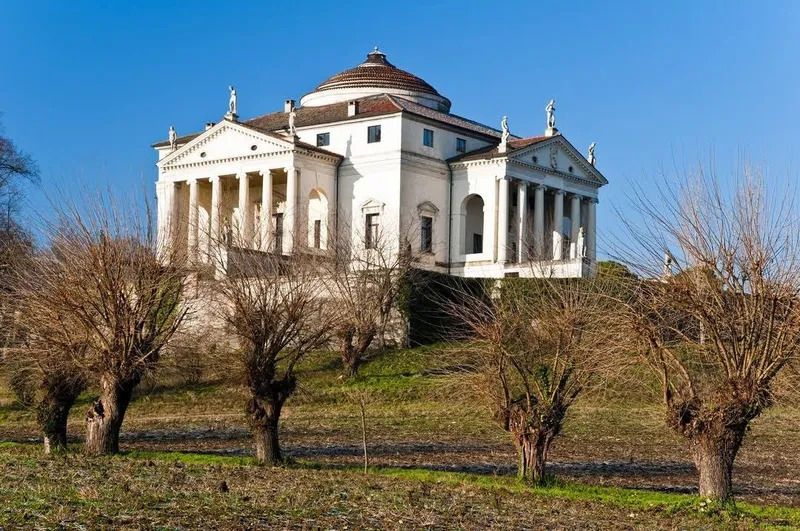

The question of which Palladian villa is the most beautiful may seem subjective, given the extraordinary quality of all of Andrea Palladio's works.
However, there is one villa that, thanks to its architectural perfection, its fame and its iconic beauty, is generally considered the most representative and fascinating expression of his creative genius: Villa Almerico Capra, also known as Villa La Rotonda.
A Unique Architectural Masterpiece:
Why Villa La Rotonda?
Designed in 1566 for Paolo Almerico, a Venetian nobleman and prelate of the Roman Curia, Villa La Rotonda is located just outside Vicenza, set within a hilly landscape that enhances its symmetrical structure. This landscape context, combined with the villa's perfect geometry, has made the building an unsurpassed model of harmony and balance. Palladio's choice to create a symmetrical central plan, with four identical façades and a large interior space topped by a dome, stems from his inspiration in classical architecture and Renaissance thought. The result is a building that appears identical from every side, perfectly symmetrical, and that engages in an ideal dialogue with its surrounding environment.
The Central Plan and the Dome: Perfect Symmetry and Harmony
Villa La Rotonda is built on a central plan, inspired by the structure of Roman temples, which gives it extraordinary balance.
The villa features four identical porticoes, one on each side, each topped by a classical-style triangular pediment, creating perfect symmetry.
At the center of the villa is a large circular hall topped by a dome, an element Palladio chose as a tribute to ancient classical buildings, but which at the same time represents an innovative solution for a private residence. The dome creates a breathtaking sense of verticality and spatiality, symbolizing a connection between earth and sky, and adding a sense of solemnity to the design.
This architectural choice makes La Rotonda unique among Palladian villas, giving it a monumentality usually reserved for religious or public buildings, but transposed here into a residential context. Such a solution had never before been adopted for a private villa, and thus represents an innovation that only Palladio's genius could conceive.
Interaction with the Landscape: A Dialogue Between Architecture and Nature
Villa La Rotonda is designed not only as an architectural building, but as a work of art integrated with the landscape. Situated on a hill, each side of the villa offers a different view, allowing visitors to admire the Venetian countryside from different perspectives depending on which portico they look out from.
The villa's elevated position and symmetry make the building appear in perfect balance with the surrounding nature, highlighting the beauty of the landscape and making it an integral part of the architectural experience. This dialogue between architecture and nature was a central element of Palladio's philosophy, who designed his villas as spaces connecting man and the environment.
Decorated Interiors: Beauty and Artistic Refinement
The interiors of Villa La Rotonda, decorated with frescoes of exceptional quality, complete the architectural work, making each room an expression of Renaissance aesthetic philosophy. The walls and ceilings are decorated with mythological scenes and allegories that evoke the themes of time and eternity, presenting the villa as a symbol of a noble and contemplative ideal of life.
Although the furnishings and frescoes were completed after Palladio's death, the interior atmosphere is perfectly in tune with Palladio's vision: a place where art, architecture and philosophy merge into a total aesthetic experience.
The Impact of Villa La Rotonda on Later Architecture
The fame of Villa La Rotonda is not limited to its beauty and uniqueness. This building has had a profound and lasting impact on Western architecture, influencing the development of the Neoclassical style in Europe and the Americas. The model of the central plan and the façade with pediment and columns has been echoed in countless historic buildings, from English country houses to grand private residences, and even in institutional architecture in the United States, such as Thomas Jefferson's Monticello.
Jefferson himself described Villa La Rotonda as a "perfect building," acknowledging its contribution to defining a new architectural language. Palladian architecture, through La Rotonda, made the idea of classical harmony and beauty accessible and desirable throughout the Western world, helping to spread a timeless model of elegance and perfection.


Comments